TET2

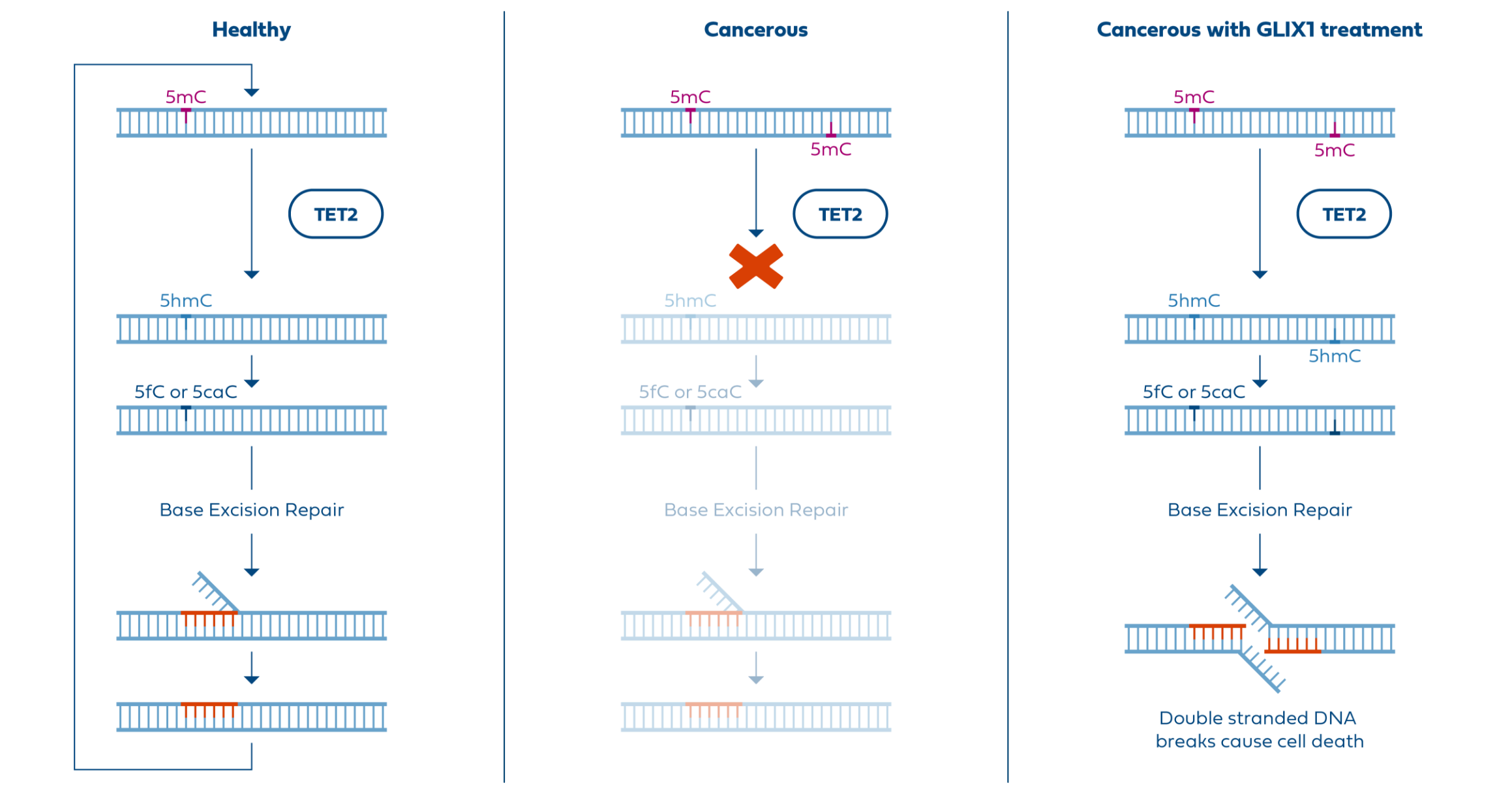
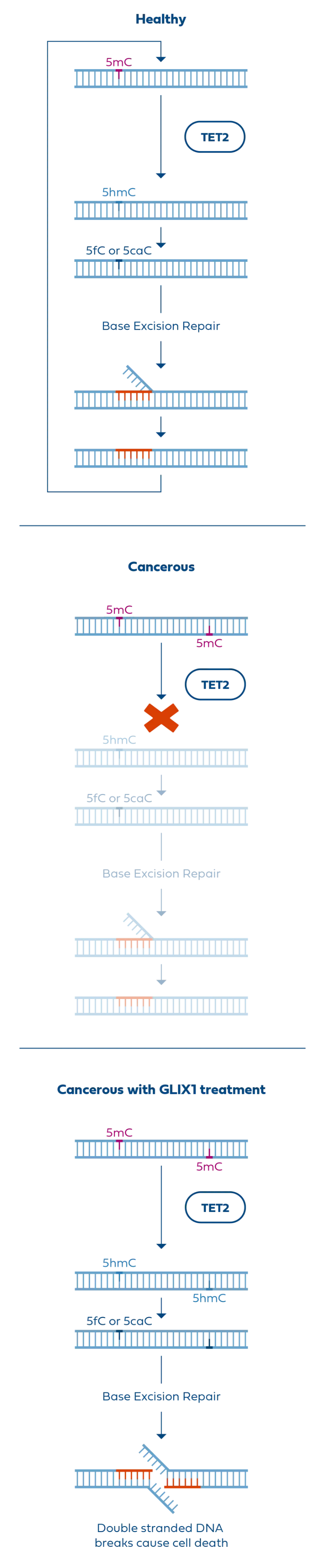
DNA methylation and demethylation form a tightly regulated cycle that is essential for maintaining normal cellular function. A key initiator of this cycle is TET2, an enzyme that catalyzes the early steps of DNA demethylation. During active demethylation, TET2 oxidizes methylcytosines, a natural consequence of which is single-stranded DNA breaks.1


In cancer, this balance is frequently disrupted. Commonly, tumors produce oncometabolites that directly inhibit TET2 activity.2 When TET2 is suppressed, the demethylation cycle stalls, leading to accumulation of methylcytosines in abnormal abundance and in certain regions of the genome.


Restoration of TET2 activity initiates demethylation, generating closely spaced single-stranded DNA breaks, and when these accumulate in close proximity, they convert to double-stranded DNA breaks. In sufficient numbers, the number of DNA breaks exceeds the repair capacity of the cancer cells, triggering cell death.3

White Curve Shape
White Curve Shape

GLIX1

GLIX1 is a first-in-class, oral medication that targets DNA damage repair by restoring TET2 activity. Resected tumor tissue has confirmed that GLIX1 enhances TET2 activity, resulting in increased 5-hydroxymethylcytosine (5hmC) in tumor cells. Given the nature of the mechanism of action – restoring TET2 activity in cancers where it is pathologically silenced – GLIX1 targets the killing of cancer cells while sparing normal cells.

Schematic showing impact of TET2 on DNA methylation and repair in healthy cells, cancer cells, and GLIX1-treated cancer cells

GLIX1’s mechanism is broadly applicable; in this regard, GLIX1 has demonstrated activity in a wide range of cancer cell lines. Given the marked reduction of 5hmC in glioblastoma, strong in vitro and in vivo efficacy in preclinical models, and GLIX1’s ability to penetrate the blood-brain barrier, clinical development will start in glioblastoma. Additional cancer indications will be advanced as part of the overall development plan.

Glioblastoma

Glioblastoma is the most common and aggressive primary brain tumor, and prognosis remains extremely poor. Median survival for newly diagnosed patients with best available care is approximately 14.6 months.4,5 By 2030, the incidence is expected to reach roughly 18.5K cases in the United States and 70K cases across the eight major markets.

Standard of care for newly-diagnosed glioblastoma patients includes maximal surgical resection to the extent that it is safely feasible, followed by concurrent temozolomide (TMZ) and chemoradiotherapy, and then maintenance TMZ.6

TMZ confers only a modest improvement in overall survival, extending median survival by 2.5 months over median survival of 12.1 months with surgical resection and radiotherapy alone. Notably, the meaningful benefit is largely confined to the ~30% of patients with MGMT promoter methylation. Despite overall improved survival, patients will recur or progress, most within less than six months. Since TMZ’s FDA approval in 2005, no additional glioblastoma specific drugs have been approved for the disease. For recurrent glioblastoma, treatment options are scarce, individualized, and with no universally accepted standard of care.

Estimated total addressable market in 2030:

>$3.7B

for US + 4EU major markets + UK

Estimated diagnosed annual incidence in 2030:

18.5Kin US

70Kin major markets

Data on Temozolomide (current standard of care)

2.5 months improvement in overall survival

50-75% of patients do not respond

$1B/year peak sales while on patent

In addition to its unique mechanism, cancer-selective activity, and blood-brain penetration, GLIX1 shows efficacy in TMZ-resistant cell lines. Since most glioblastomas are initially TMZ-resistant or eventually develop TMZ resistance, GLIX1 could meaningfully expand options for this currently untreatable population and hopefully change the prognosis for this serious unmet need.


The GLIX1 first-in-human phase 1 trial is planned to recruit up to 30 recurrent glioblastoma patients. The objective is to establish a maximum tolerated dose and/or a recommended dose based on safety, PK, and preliminary efficacy. Data from the phase 1 trial is anticipated in H1 2027.

Potential cohorts for a phase 2 expansion trial could include:

  • GBM – newly diagnosed and/or recurrent
  • Additional cancers – with/without PARP inhibitor (PARPi) combination

GLIX1 and PARPi – Potential for Strong Synergy

PARP inhibitors are a very successful class of anticancer medicines. These drugs work by inhibiting PARP enzymes, preventing the repair of single stranded DNA breaks. Cells unable to repair single stranded DNA breaks via PARP must then use homologous recombination (HR) to repair this damage. Therefore, PARPi show strong efficacy in cancers deficient in HR — roughly 6% of all cancers. GLIX1 bypasses the HR requirement of PARPi by facilitating the formation of single stranded DNA breaks in cancer. Therefore, the GLIX1/PARPi combination may substantially expand the reach of cancers treatable by PARPi. Our in vitro studies, pairing PARPi with GLIX1, show synergy in HR-proficient cancers.

Publicly Available Information

References: 1. Zhu J, Yang Y, Li L, Tang J, Zhang R. DNA methylation profiles in cancer: functions, therapy, and beyond. Cancer Biol Med. 2023;21(2):111-116. 2. Da W, Song Z, Liu X, Wang Y, Wang S, Ma J. The role of TET2 in solid tumors and its therapeutic potential: a comprehensive review. Clin Transl Oncol. 2024;26(9):2156-2165. 3. Cimmino L, Dolgalev I, Wang Y, et al. Restoration of TET2 function blocks aberrant self-renewal and leukemia progression. Cell. 2017;170(6):1079-1095.e20. 4. Fisher JP, Adamson DC. Current FDA-approved therapies for high-grade malignant gliomas. Biomedicines. 2021;9(3):324. 5. National Cancer Institute. SEER. 6. Stupp R, Mason WP, van den Bent MJ, et al. Radiotherapy plus concomitant and adjuvant temozolomide for glioblastoma. N Engl J Med. 2005;352(10):987-996.

White Curve shaped
White Curve shaped
The partner of choice for drug development

Discover how our partnerships drive our pipeline and expand the potential reach of therapeutic solutions.